

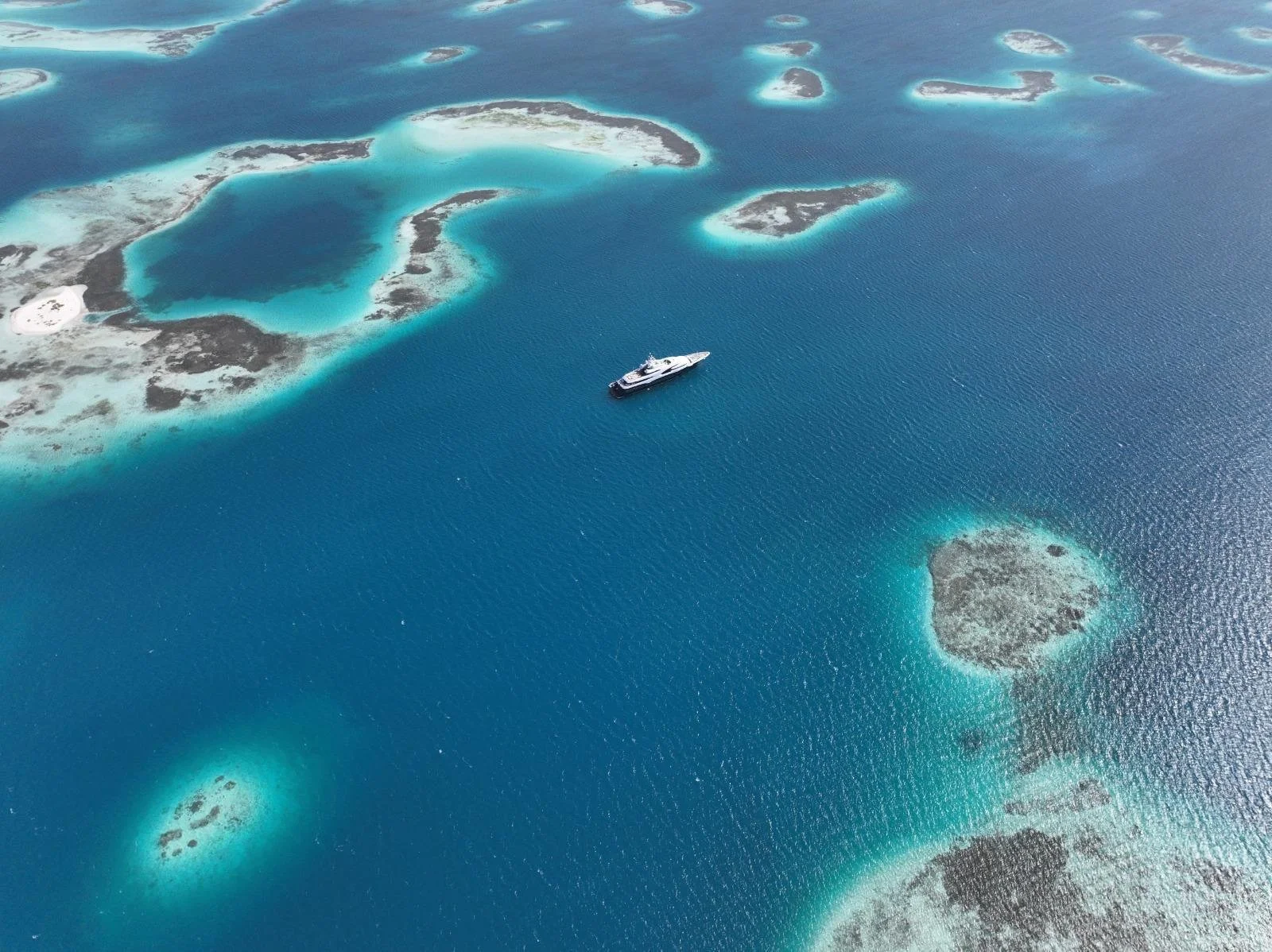
When One Yacht Became a Signal
How M/Y Barbara, M/Y Ecstasea, and One Helicopter Landing Marked a New Era for Los Roques
There are moments in tourism that do not begin with a grand announcement.
They begin quietly.
A message from a captain.
A question from a management team.
A concern about safety.
A document request.
A conversation that continues for months before anyone drops an anchor.
That is how this story began.
Not with two 80-meter yachts suddenly appearing in Los Roques.
Not with a helicopter landing on the bow of M/Y Ecstasea during Easter holidays.
Not with the images that later made everyone stop and look.
It began much earlier.
It began with trust.
For six or seven months, the conversation with M/Y Barbara was alive. Quietly, patiently, steadily. Month after month, the questions came. Is Venezuela safe? Are things changing? Are authorities opening again? Can a yacht of this size operate properly in Los Roques? Can clearances be handled smoothly? Can the owners come without complications? Can the experience match the standards expected by an 80-meter yacht?
The answer was always the same:
Yes — if it is done correctly.
Not rushed.
Not improvised.
Not sold as a fantasy.
Done correctly.
Los Roques is not a normal destination. It is not a marina where a yacht simply arrives, plugs in, and disappears into the crowd. It is a protected marine park, a rare Caribbean atoll, a place of shallow banks, reefs, sandbars, national regulations, delicate ecosystems, and extraordinary beauty.
To bring a vessel like Barbara here required more than enthusiasm.
It required months of reassurance, preparation, information, operational planning, authority coordination, and personal credibility. It required explaining that the image many people had of Venezuela was not the reality of Los Roques. It required showing that things were changing, that official channels were opening, that safety was being handled seriously, and that a new level of yacht support was now possible.
Barbara did not come because of a brochure.
Barbara came because trust was built.
And when she arrived, everything changed.
First, the captain came to explore.
To see.
To feel the place.
To understand the anchorages, the channels, the procedures, the rhythm of the islands.
Then the owners came.
And for more than seventeen days, M/Y Barbara experienced Los Roques the way it was meant to be experienced — privately, calmly, surrounded by turquoise water, white sand, safe anchorages, and a level of local support designed to make the entire operation feel effortless.
Clearance.
Permits.
Pilot coordination.
Daily logistics.
Guest support.
Provisioning.
Authority liaison.
Anchorage planning.
Operational follow-up.
Departure procedures.
Everything had to work.
And it did.
The service was not just good.
It was five-star.
Not because it was loud.
Not because it was trying to impress.
But because it gave the captain, crew, owners, and guests the one thing every great yacht operation needs:
Confidence.
The confidence that someone local had everything figured out.
The confidence that the yacht was not alone.
The confidence that behind every movement, every permit, every anchorage, and every request, there was a team that understood both the destination and the standard.
And then the most powerful form of marketing happened.
Not advertising.
Not a campaign.
Not a post.
A captain spoke to another captain.
Barbara’s experience became a recommendation.
The message was simple:
Come to Venezuela.
There is someone here who has everything figured out.
This place is paradise.
That is how M/Y Ecstasea entered the story.
Not through a cold lead.
Not through a sales pitch.
Through trust passed from one captain to another.
That is the real turning point.
Because in the superyacht world, trust does not come easily. Captains do not recommend destinations lightly. They do not send friends into uncertainty unless they are confident the operation will be handled properly. Their reputation is connected to every recommendation they make.
So when Ecstasea came after Barbara, it was more than a second yacht.
It was validation.
It meant the first operation had worked so well that it opened the door for the next one.
And then, in the middle of Easter holidays, Ecstasea arrived.
Los Roques was alive.
The islands were full of movement.
Authorities were alert.
Logistics were sensitive.
Timing mattered.
Coordination mattered.
Safety mattered.
And then the moment came.
A helicopter descended onto the bow of M/Y Ecstasea in Los Roques.
It was not just an aviation movement.
It was a statement.
A statement that Venezuela can receive the world’s largest private yachts.
A statement that Los Roques is ready for serious superyacht operations.
A statement that when local knowledge, authority coordination, captain trust, and professional execution come together, things people once thought impossible can happen.
For many people watching from the outside, it was just a spectacular image.
For those who understood what it took, it was something much bigger.
It was months of work landing on one deck.
It was trust becoming visible.
It was Venezuela showing a different face to the world.
For too long, this country has been seen through uncertainty.
Headlines spoke louder than the sea.
Politics became the story.
Fear traveled faster than reality.
And while the rest of the Caribbean became busier, louder, more crowded, and more predictable, Los Roques stayed almost impossibly pure.
Still blue.
Still quiet.
Still protected.
Still waiting.
But this year, something shifted.
Barbara came.
Barbara stayed.
Barbara trusted the destination.
Then Ecstasea came.
And suddenly, Los Roques was no longer just a hidden paradise whispered about by sailors, fishermen, and the few captains who knew. It became a real operational case study for the superyacht industry.
Two 80-meter-class yachts.
One protected national park.
Complex clearances.
Remote pilot supervision.
Daily concierge operations.
Guest logistics.
Aviation coordination.
Helicopter movement.
Multiple authorities.
Real compliance.
Real pressure.
Real execution.
And the system held.
That matters.
Because tourism is not rebuilt with slogans.
It is rebuilt with proof.
One captain at a time.
One successful arrival at a time.
One owner experience at a time.
One clean clearance.
One safe anchorage.
One well-managed itinerary.
One recommendation passed privately between professionals.
That is how reputation returns.
Not by shouting.
By performing.
Los Roques does not need thousands of yachts.
It needs the right yachts.
It needs vessels that understand the value of privacy, nature, discretion, and protected beauty. It needs captains who respect the rules. It needs owners who appreciate that true luxury is not noise, congestion, or another beach club full of the same faces.
Here, luxury means distance.
It means anchoring with no other yacht in sight.
It means hearing only the wind, the tender, and the water moving against the hull.
It means watching the sun fall behind a sand cay that feels like it belongs only to you for a few hours.
That is the experience Los Roques offers.
A Pacific-style atoll feeling without crossing the Panama Canal.
A sense of remoteness without leaving the Caribbean program behind.
A place that feels wild but can be operated professionally with the right team.
That is the balance.
And that balance is exactly what Yachtservice Los Roques has now proven it can manage.
The operations with Barbara and Ecstasea did more than create beautiful memories. They helped solidify a professional service structure for vessels over 200 GRT: formal clearance and government coordination, approved remote pilot supervision, dedicated daily concierge and operational support, and transparent operating expense coordination.
That structure was not theoretical.
It was tested by real yachts, real captains, real owners, real holiday pressure, and real operational demands.
It was built in the field.
And that is why it matters.
Because anyone can write that they provide yacht services.
Anyone can say they handle logistics.
Anyone can promise paradise.
But very few can take an 80-meter yacht through a sensitive protected marine park, coordinate authorities, manage clearances, support owner-level operations, organize aviation movements, and still make the experience feel natural, private, and smooth.
That is the difference.
Barbara proved the destination could be trusted.
Ecstasea proved the model could scale.
The helicopter landing proved what was possible.
Together, they became a message to the world.
Venezuela is not only a headline.
Los Roques is not only a memory.
This destination is alive, capable, protected, and ready for the right kind of yacht tourism.
And the impact goes far beyond the yachts themselves.
When vessels like Barbara and Ecstasea come to Los Roques, the opportunity touches everyone.
Local pilots.
Boat operators.
Provisioning suppliers.
Transport providers.
Aviation teams.
Hotels.
Restaurants.
Guides.
Maintenance support.
Government services.
Young people who see that world-class tourism can happen here again.
That is how an economy starts moving.
Not through mass tourism that damages the place.
But through high-value tourism that respects it.
Not by filling the park with volume.
But by bringing carefully managed operations that create real value while protecting the very thing that makes Los Roques irreplaceable.
This is the future.
Selective.
Professional.
High-value.
Environmentally conscious.
Built on trust.
Built on service.
Built on results.
The world does not need another crowded Caribbean stop.
It needs places that still feel real.
Los Roques is one of them.
And perhaps that is why this story feels so important.
Because it was never just about one yacht.
Then it was never just about two yachts.
And it was never only about a helicopter landing.
It was about a door opening.
A door that had been closed by perception, uncertainty, and years of people assuming Venezuela was no longer an option.
Barbara opened that door.
Ecstasea walked through it.
And Los Roques, quietly and without changing who it is, reminded the yachting world of something powerful:
Paradise was still here.
It had not disappeared.
It had not lost its beauty.
It had not stopped being safe, wild, and unforgettable.
It was simply waiting for the right people to believe in it again.
Now they have.
And the next chapter has already started.

Rebuilding Paradise: A New Era for Los Roques
A forgotten paradise finds its voice again.
There are places that don’t need to shout to be heard.
Los Roques has always been one of them.
While the world was busy arguing over politics and headlines, these islands stayed exactly as they’ve always been — bright, silent, and impossibly blue.
Eighty miles from the Venezuelan coast, the atoll kept breathing quietly, waiting for the rest of the Caribbean to remember what real paradise looks like.
Now, little by little, that silence is breaking.
Anchors are dropping again.
Captains are calling in from the horizon.
And those who thought this place had disappeared are realizing it never went anywhere.
Los Roques isn’t just another tropical postcard. It’s a living atoll — a rare geological formation that rose from the Caribbean Sea around ten thousand years ago.
Forty-two islands. Three hundred islets. Hundreds of reefs and sandbars that change color with the light.
Every beach tells a different story:
Cayo de Agua, where two tides meet to form a strip of white so pure it looks unreal.
Noronquí, where turtles glide through glassy water.
Crasquí, the favorite anchorage of sailors who never really leave.
Photographer Federico Cabello once said that Los Roques forces you to “see more.”
He was right. The longer you look, the more you start noticing things — the slow rhythm of the tides, the silence that hums, the hundreds of shades between blue and turquoise.
During the pandemic, when marinas across the world fell silent, something unexpected happened.
Yachts started looking for new routes — quieter, safer, more remote.
Los Roques was already here, waiting.
While the rest of the world was locking up, Venezuela quietly opened its sea again.
Clearances that used to take days now happen in minutes.
The local economy dollarized.
And a new generation of maritime professionals began doing things differently — fast, organized, transparent.
That’s how Yachtservice Los Roques became what it is today: the easiest, most reliable way to enter Venezuelan waters.
Captains talk about it on the radio like a secret that shouldn’t be a secret anymore.
The truth is, Los Roques doesn’t need a thousand yachts. It needs the right ones.
This is not St. Barth or St. Martin.
There are no nightclubs, no crowds, no marina full of horns and champagne foam.
Here, luxury means privacy.
It means a perfect anchorage where you hear nothing but your own heart beating under the stars.
Like Malta in the Mediterranean, Venezuela is learning that small, well-managed destinations can protect both nature and reputation.
That’s why every yacht that comes here does so under a strict environmental framework — limited-entry permits, approved anchorages, waste control, reef protection.
It’s not red tape. It’s respect.
If you’ve ever entered Los Roques, you’ve probably heard the name Alejandro Linares.
He’s been around these islands for over thirty years — long before there were GPS routes or drone shots to show the way.
He was the guy who knew the right moment to catch a marlin, the exact color of the lure to use, and the safest channels to cross when the light was low.
Today, as the founder of Yachtservice Los Roques, he’s using that same instinct — only now it’s for superyachts, pilots, and captains who want to experience the islands the way they were meant to be experienced: free, effortless, unforgettable.
Alejandro and his team coordinate everything — visas, clearance, provisioning, local pilots — quietly, efficiently, like clockwork.
Because the best kind of service is the one you barely notice.
Los Roques isn’t trying to compete with anyone.
It doesn’t have to.
The world’s biggest yachts are already starting to come — drawn by the same thing that brought fishermen here centuries ago: calm water, safe anchorages, and a beauty that still feels untouched.
This isn’t a comeback story. It’s continuity.
The islands never fell. We just stopped listening.
Now, the world is listening again.
If you’re looking for somewhere real — somewhere that still feels wild and safe and alive — you’ve already found it.
Still ours. And still yours.

David vs. Goliath: Los Roques and the Rebirth of Venezuela’s Story
Every era has its Goliath. For us in Venezuela, Goliath has not been a single man, but a machine — the endless stream of propaganda, the weight of oil interests, and the headlines that have tried to define us as unsafe, unstable, and unworthy.
But David’s story has always been about resilience. And resilience is what defines Los Roques, our people, and our way of life.
For decades, Venezuela has been cast aside, banned from air routes, shut out of financial systems, and treated as if turmoil was our only identity. Yet if you look around the world today, every nation wrestles with its own storms — protests, corruption, economic struggles, coups. The difference is that Venezuela was marked and magnified as the symbol of it all.
That was never the full story.
The truth is, Venezuela is one of the 17 megadiverse countries on Earth. We hold the third-largest freshwater reserves in the world, vast rainforests, endless Caribbean coastlines, and more than ten untouched islands with sand as white as flour and waters painted in eight shades of blue.
Here in Los Roques, just 80 miles offshore, lies something rare — a Pacific-style atoll in the middle of the Caribbean, completely outside the hurricane belt. Anchorages lie empty. The biodiversity is unmatched. The horizon feels endless. And what brings this place alive is not only its natural beauty but the service and warmth of its people. From a fisherman sharing his catch, to a family welcoming guests with a smile, to the ease with which a yacht is cleared in under 20 minutes — Los Roques speaks louder than any headline. It proves that Venezuela is safe, thriving, and welcoming.
Yes, Venezuela has its challenges. Boats have been stolen, resources fought over, politics debated. But which country doesn’t have its shadows? What we don’t have is the identity forced on us: a so-called narco-state. Here, even a joint can land you in jail. Drugs are not our culture. Our wealth has always been in oil, in gold, in water, in biodiversity — and in the resilience of our people.
That richness is precisely why outsiders have tried to control the narrative. It is easier to paint Venezuela as dangerous than to admit the truth: this is one of the richest and most beautiful countries on Earth. And so, despite the noise, Los Roques rises. Every yacht that anchors here, every guest who walks barefoot on our beaches, every captain who expected chaos but found ease and safety — each is proof that the story is changing. What they discover is not the caricature of Venezuela painted abroad, but the reality of a nation with open arms, where there is no racism, no walls of religion, only hospitality and a will to thrive.
David never defeated Goliath with size. He did it with truth and precision. In the same way, every visit to Los Roques is a stone in the sling — small on its own, but powerful enough to shift perception. This battle was never about strength. It was always about perspective. And here, in Los Roques, Venezuela is reclaiming its story — one boat, one guest, one unforgettable day at a time.
Still ours. And still yours.
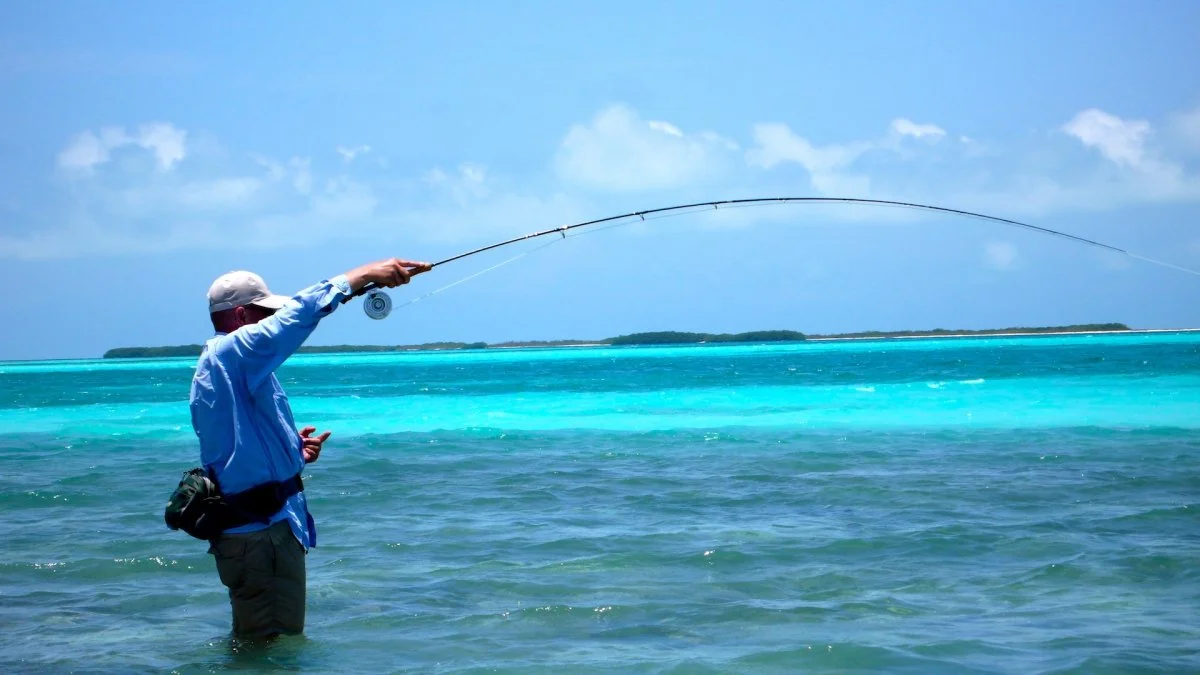
Los Roques: The Anglers Best-Kept Secret
The 45-minute flight from Caracas to Gran Roque is unlike any other journey in the Caribbean. As the plane lifts off, the haze of the mainland quickly dissolves into sunlight, and ahead, the sea transforms into a living canvas — a spectrum of blues and greens so intense it feels unreal. By the time the scattered cays of Los Roques come into view, the excitement on board is palpable. Everyone knows they’re about to step into something extraordinary.
For years, Venezuela was misunderstood. Headlines painted a picture of turmoil, but the reality today is completely different: a nation stable, safe, and open for tourism like never before. Nowhere is this more evident than in Los Roques, a national marine park that feels more like a South Pacific atoll than a Caribbean island. Remote yet accessible, unspoiled yet welcoming — it is paradise rediscovered.
From the moment you land, the difference is clear. Alejandro from Yachtservice Los Roques organizes every detail seamlessly: permits, clearances, and the warm welcome that puts any lingering doubts to rest. A few steps from the airstrip and you’re already in barefoot paradise, walking sandy streets lined with hibiscus and bougainvillea. Life here runs on island time, friendly and unhurried.
And then comes the fishing. Los Roques is world-famous for its Pancake Flats — firm white sand, ankle-deep water, and tailing bonefish in endless numbers. Wading across these flats, every cast holds the promise of that explosive run that makes bonefish legendary. Above average in size and unmatched in spirit, the fish here remind you why this archipelago is considered one of the finest fly-fishing destinations on earth.
Yet bonefish are only part of the story. Tarpon lurk in mangrove lagoons, jacks and snapper patrol the beaches, while parrotfish and triggers tempt anglers with their power and stubbornness. Variety is everywhere, and every encounter is played out against the impossible backdrop of Los Roques’ turquoise waters.
And then, of course, comes the offshore adventure. Alejandro didn’t join us for bonefishing, but when it was time to head offshore, his 20+ years as a captain came alive. He knew the spots, the moon phases, the right lure colors — and the results were mind-blowing. In just one long day on the water, we hooked everything: wahoo after wahoo, yellowfin tuna, mahi-mahi, and even fought multiple blue marlin. Ten hours of pure adrenaline, ending with the freshest fish feast we had ever caught ourselves. Glorious days to remember — the kind that turn a trip into a lifetime memory.
Step offshore, and Venezuela shows why it is recognized worldwide as the land of double and triple billfish catches. Blue marlin, sailfish, and white marlin are part of the country’s legendary big-game history. Move inland, and the rivers and lagoons offer another prize: the largest peacock bass on the planet. No other country can deliver this combination — bonefish in saltwater, white and blue marlin offshore, and peacocks in freshwater.
What makes it all unique today is the sense of space. Los Roques is still free of crowds, still pristine, and still safe. For fishermen, sailors, and travelers, it is one of the last true frontiers of the Caribbean — a place where exclusivity comes not from walls or gates, but from nature itself.
Los Roques is not forgotten. It has simply been waiting.